Saturday, August 20, 2011

Devil's Kitchen in the Morning

Devil's Kitchen in morning light.

The Devil's Kitchen on the Nebo Loop Scenic Byway (near Nephi, Utah), is a great geological site.  These conglomerate rock formations stand out in their deep red color against the green trees and shrubs.  It was interesting to visit in the early morning hours.  Besides the ubiquitous cows on the highway, we saw several deer.  Watching the light spread over the small canyon was a visual treat.

Early morning at Devil's Kitchen.

The morning sun gave Devil's Kitchen an ethereal quality.  It seemed almost misty, although it was only the rays of sunlight.

Mt. Nebo in the distance.

The morning sun lit up the eastern slope of Mt. Nebo.  From an overlook, we could see the ridges in front of Mt. Nebo contain the same red conglomerate rock that forms the Devil's Kitchen.

View from the Devil's Kitchen overlook.

Tree at the overlook.

I loved the way the sunlight highlighted the twists and turns of this wonderful old tree.  Devil's Kitchen is a great place to stop if you get the chance.  It is beautiful at any time of day!


Friday, August 19, 2011

The Art of Camp Cooking - Breakfast

This year on our camping trip we decided to go with simple, traditional camp cooking.  Our son introduced us to a breakfast we hadn't tried at camp before:  omelets in a bag (big shout out to his Scout leader!)  I was a bit skeptical, not really wanting to eat something with the consistency of powdered eggs, but this was a simple, savory breakfast with almost no clean-up.

Omelet in a bag - step one

First, prepare your omelet ingredients.We had diced ham, chopped chicken, onions, green peppers, cheese, and salt and pepper.  Everyone assembles their own customized ingredients into their individual quart-sized plastic freezer bag.

Add your eggs!

After you put in your ingredients, break an egg or two into your bag, and mash it up until the egg and all ingredients are mixed together.  (Don't get shell in your bag, unless you want your omelet to have extra crunch!)  Squeeze all the air you can out of the bag, seal the zip opening, and then put it in a pot of boiling water.  We boiled our water on a Coleman camp stove. Check your bag once in awhile, and swish it to other spots in the pot so that  it cooks evenly.  (Sorry, I didn't time how long this takes, but allow several minutes...the eggs are thicker cooking them this way).  You can cook several omelets at once.

Remove your cooked omelet from the bag.

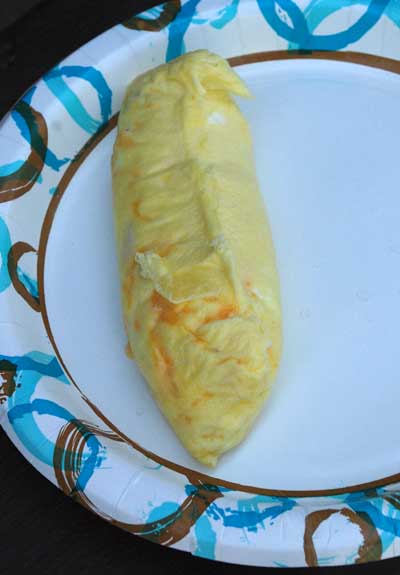
When your eggs are the consistency you like, remove the bag, empty it on a plate, and enjoy your "breakfast burrito!"  These were very delicious, and I think we'll do these at home on the stove on those mornings when everyone wants an omelet at once.

Voila!  Omelet from a bag.

Breakfast is served!

I don't know what it was about this cooking method, but the flavors from the onions and peppers really permeated the omelet, and it was delicious!  Besides, everything tastes better outdoors.

If you are concerned about cooking in plastic bags, you may want to read up on it.  Here is one link that might be helpful.  I think the risk of a once-a-year bag omelet is worth it for the convenience and taste!

Wednesday, August 17, 2011

The Devil's Kitchen


Tucked away on the Nebo Loop Scenic Byway not far from Nephi, Utah, is the Devil's Kitchen Geologic Interest Site.  The red rock seems incongruous with the green forest, but as you drive the byway, you notice that a lot of the mountainsides are made of the same materials.  One of the wonderful things about Utah is the large areas of exposed geology.  Note that the Devil's Kitchen faces west, and is backlit by the morning sun.  We returned later in the afternoon to get these photos.

Conglomerate Rock Formations, Devil's Kitchen, Utah

This overlook is nicknamed the "mini-Bryce Canyon", and you can see why.  However, it only takes a few minutes to realize instead of weathered sandstone, these formations are conglomerate rock.  You can see the mixture of other stones in the formation, as if  someone mixed gravel in red mud and then sculpted with it.
The Utah Geological Survey site has interesting details about the geology and formation of Devil's Kitchen.  It also indicates there are 34 places in the United States with the moniker Devil's Kitchen, and three of them are in Utah!  (I don't know why this name is so popular.)  At the overlook, read the signs to identify shapes such as the Saddlehorn.

The Saddlehorn

If you are traveling north on the Nebo Loop Scenic Byway, you will see a sign indicating a "Point of Geologic Interest" about 500 feet before the parking lot for Devil's Kitchen.  From the parking lot, follow the paved trail leading to the overlook.  It is about 200 yards through shady forest, and is wheelchair accessible.  This point is at about 9000 feet in elevation, so you may notice the altitude.

Picnic Area at Devil's Kitchen

There are three picnic tables tucked back in the trees, and a vault toilet at the trailhead.  There are no other facilities, and like many other places along this route, there is a "if you pack it in, please pack it out" policy, so if you picnic, please take any garbage out with you!

If you face west from Devil's Kitchen, you get a great view of Mt. Nebo

We enjoyed driving the Nebo Loop Scenic Byway, and stopping for sites and hiking along the way.  At Devil's Kitchen, my husband even took time to paint.  Look here if you'd like to see more information about his painting experience that day!

Painting at Devil's Kitchen


Monday, August 15, 2011

Gilgal Garden

Near the entrance of Gilgal Garden

Gilgal Garden is the result of the vision and work of one man, Thomas B. Child, Jr.  Although he was not a trained artist, he was a stonemason, and this little garden is his own private art project.  Now a city park, Gilgal is open to the public, and is a peaceful little place near Trolley Square in Salt Lake City.

A wider view of Gilgal Garden

A community group saved this garden after Child's death, and now it is protected from threatened demolition and development.  I had no idea what to expect when I visited, but found an intriguing glimpse into someone else's artistic vision.

Photo of garden construction

Along the back wall are some pictures of Child and the construction of the garden.  When you consider the size and placement of all the rocks, and the sculptures themselves, this was an enormous undertaking.


Sculpture representing Daniel 2 from the Bible

Many of the stones include carvings of hymns and scripture references.  This hill of scattered parts has a sign indicating it represents Daniel's vision from the Bible.  If you take the time to read all of the references, you will need to allow at least an hour at the garden.

View facing southwest in Gilgal Garden

There is such an eclectic variety of things in this place:  the archway, a pile of books, an angel Moroni on a spire, and more.  I found myself wondering if Thomas Child had an overall vision when he began, or if he just started building, and then added random things as he went along.

Sculptures in Gilgal Garden

Child made this sculpture of himself

I am not sure what the head means in this piece.  Note the grasshopper in the front.

View of Gilgal facing east.


This figure, minus a carved head, is near the entrance of the garden.

The famous sphinx sculpture

Descriptions and photos of Gilgal almost always include this famous sphinx, carved with the face of Church of Jesus Christ of Latter-day Saints prophet Joseph Smith.

Flowers in bloom at Gilgal

Sections of this garden are planted with flowers that were blooming beautifully on the day I went.  It is not only a place of art, but, ultimately, a nice little garden tucked back off the busy streets.  This would definitely be a nice respite during a lunch hour, or a fun stop before dinner at Trolley Square.

Flowers at Gilgal

If you go, Gilgal Garden is open to the public from 8am to 8pm from April through September.  During October through March, it is open 9am to 5pm.  It is closed Thanksgiving, Christmas, and New Year's.  There is a limited amount of free parking on the street in front of the garden entrance.  The garden is located at 749 East 500 South in Salt Lake City.


Friday, August 12, 2011

The Art of LeConte Stewart

Springtime, Morgan Valley - by LeConte Stewart

So, it is happening again!  I have been to a couple of art exhibits this summer, and that urge to pick up a pencil and sketchpad or paintbrush is starting to build.  That crazy voice in my head is saying "I want to do that," as I look at a wonderful piece of art on display.  Visiting art galleries makes me believe that I could do that too!  The inspiration this time comes from the "LeConte Stewart:  Depression Era Art" exhibit at the Utah Museum of Fine Art.  This is actually only part of a joint LeConte Stewart (1891 - 1990) show, with the other half, "LeConte Stewart:  The Soul of Rural Utah" at the Church History Museum.

There are many wonderful things about this exhibit.  First, this collection of Depression-era paintings demonstrates an artist's contribution as an historian.  As you view paintings like "Lincoln Hotel, Furnished Rooms" (1935) or "Home Loan" (1936) depicting a home vacant due to a foreclosure, you get an idea of the hardships of everyday life during the 1930s.  "Private Car" shows men riding on the Union Pacific trains in search of work, and is another historical scene captured on canvas.

"Private Car" - LeConte Stewart

A second great feature of this exhibit is the opportunity to see Stewart's paintings of the same subject matter.  For example, you can see "Ogden, Becker Brewing" (1933) and next to it "Becker's, Sunday Afternoon" (1933) showing the same building from a different point of view and at a different time of day.  There are several paintings grouped like this in the exhibit, like "Red Fire Plug" (1935) and "Watson's House" (1935).  If you get the chance to see this exhibit at UMFA, take a moment to compare these paintings.

"Smith's House" - LeConte Stewart

I loved being able to view a first and second study of "Smith's House," and then see the final piece.  The first study is a rough blocking in and beginning of color and value.  The second study is more defined, and it is interesting to notice the changes between it and the final piece.  In the final painting, the orange light in the window is played up, and the billboard on the right hand side of the painting is toned down in both value and color.  This focuses your eye on the central building in this painting, and is a wonderful example of making a good composition better.

LeConte Stewart was clearly a master of lighting.  The paintings in this exhibit show warm afternoon light, flat outdoor light, the subtle light of evening and night, and all of the light that plays on snow.  There are several "snow" paintings in the show, and I noticed a quote by Stewart that says he saw "an infinite number of color variations" in winter.  I loved the warm light of "Double Gables" (1935), and the colors of the snow in "Snow Banks" (1940).

"Pea Vinery, Layton" - shows warm daylight

"Winter Evening, Eden", though not in the show at UMFA, demonstrates the subtle light on evening snow.

I also enjoyed the fact that LeConte Stewart managed to take ordinary subject matter, like houses, or a dirt road, or mailboxes, and render them in such a way that they are "art."  This exhibit showcases a variety of mediums in Stewart's work, including pencil, conte crayon, watercolor, and oil.

"Approved by the Postmaster General" makes the ordinary a work of art.

This exhibit runs until January 15, 2012, so you have plenty of opportunity to stop in and see it.  UMFA has free admission on the first Wednesday and third Saturday of each month.  The Church Museum of Art is free.

Here are my ART GALLERY TIPS:

1)  Look behind you!  Often a painting that looked pretty good up close, is stunning from across the room.
2)  Fall in love. You'll know the painting you like.  It is the one you study up close, and then look at again and again from across the room.  It will be the one that resonates with you, that calls you back for another look.  It is the painting you have to see one more time before you leave.  It's the picture that beckons you to step inside, that invites you to journey into its world, the one you wouldn't get tired of hanging in your living room.

One of my favorite paintings in this exhibit was, unfortunately, untitled.  So, if you go, look at "Untitled" (1927), and see if you like it, too.  It shows a house, and sagebrush, and a dirt road set against a background of mountains, and looks like a place you could stay awhile.  If you see it, let me know what you think!  I suspect I'll go visit it again before this exhibit ends.


Church Art Museum

Utah Museum of Fine Art