
Ruins at Hovenweep
Sitting atop the Cajon Mesa, the ruins at Hovenweep rest in a stark, yet peaceful environment. We visited the Little Ruin Canyon area next to the visitor's center at Hovenweep, and this national monument quickly became one of my very favorite places. When we returned home from our whirlwind trip through southeastern Utah, Hovenweep was the place I missed.

Sign at Hovenweep
Hovenweep was designated as a national monument in 1923 by President Warren G. Harding. Hundreds, if not thousands of ruins dot its landscape. It is noted for its amazing towers rising from the sagebrush-covered ground.

Twin Towers at Hovenweep
Most visitors to Hovenweep walk the rim of Little Ruin Canyon to see the Square Tower group of ruins. Because it is a rim walk, the trail is pretty flat, and is an easy hike. Only the portion to the first overlook is paved and wheelchair accessible, however. The rest of the trail is primitive and wends its way over dirt and rock. Near the end of the loop, the trail dips down into Little Ruin Canyon, and there is a bit of a climb back to the rim, but it is still an easy hike.
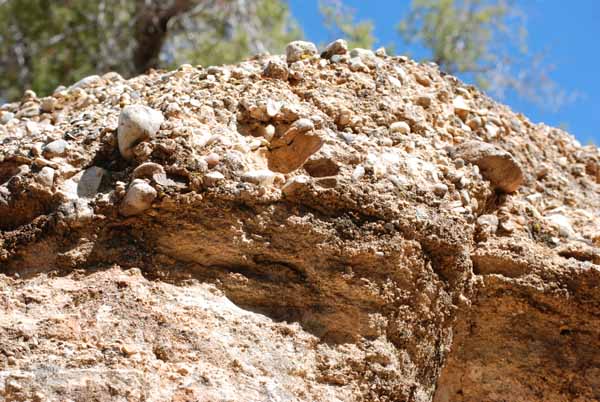
Conglomerate rock on the trail out of Little Ruin Canyon
One thing I noticed as we walked out of the canyon was the layers of conglomerate rock at Hovenweep. A pattern of oceans and uplifts created the geology here.

View of Square Tower in Little Ruin Canyon
Hovenweep is near the Utah-Colorado border, and there is evidence of interaction between the people who occupied this site, and the residents of Mesa Verde. The Square Tower group of buildings hit its peak occupation during the Pueblo III period. Archeaological finds show limited occupation of this area during earlier periods. Once this land was cultvated, not covered in sage brush as it is now.

Towers at Hovenweep
Another thing that sets the ruins at Hovenweep apart is their remarkable preservation. This is highly unusual because the buildings are exposed to the elements, not sheltered under cliffs as many Puebloan ruins are. There are places along the trail where you can view the incredibly skilled construction of these walls.

Detail of wall construction at Hovenweep
One of my favorite things about Hovenweep was the solitude. If you want a stop away from the normal crowds at Utah's national parks, Hovenweep is well worth the drive. We shared the rim trail with a handful of people on the day we visited (early spring), but since we were all hiking at a different pace, we had plenty of time alone.

The Castle at Hovenweep
It is hard to choose a favorite building at Hovenweep. I was impressed by Boulder House--a building literally constructed in a large rock in the canyon. But the beauty of the Castle ruin was undeniable.

Boulder House - tucked in the rock.
We shared the canyon with crows and other birds, lizards, and a rabbit on the day we visited. Watching the local populace was part of the fun.

Rabbit at Hovenweep
The Hovenweep site dates from the same time period as the cliff dwellings at Mesa Verde. The buildings of this era are more varied and elaborate. An astronomer found that the ports in the tower at Hovenweep castle mark the solstices and equinoxes. The families who lived here controlled the water seep at the mouth of the canyon, built a large number of buildings, and farmed the land. It was a significant community in the early 1200s.

Square Tower in Little Ruin Canyon
If you go: Hovenweep National Monument is about an hour's drive from Blanding, Utah. You can see the Little Ruin Canyon area in about two hours. Camping is available at the monument, and the visitor's center has restroom facilities, water, and a gift shop. Spring and fall are the best time to visit, as temperatures can soar above 100 degrees Fahrenheit in the summer. The monument is open year round, however the visitor's center is closed on Thanksgiving Day, Christmas Day, and New Year's Day.

Share Hovenweep with a friend! Dave Darinko at Hovenweep.


