Thursday, November 14, 2013

Julius Caesar, Hunger Games, and More


My son was assigned to read Julius Caesar by William Shakespeare this summer for his upcoming English class.  I had to read it when I was in high school, as did my other two children.  I have read it again with each of them, and now, on my fourth time through, I have decided that I am really starting to understand this play. Despite the tragic elements, Shakespeare manages to throw in some funny moments. However, I realize as I look at the play through the prism of adulthood, it isn't my favorite.  Brutus seems weak and easily swayed. In fact, I am not sure why I liked his character when I read this play as a teenager. Cassius, on the other hand, is completely devious and manipulative, and Caesar is blind to the things going on around him.


Many phrases we are familiar with in the English language come directly from Shakespeare. The obvious one in Julius Caesar is "Beware the Ides of March."  However, I noticed on this reading, that there are other things in Julius Caesar that have been used recently in books. Two phrases from the play have been used as titles:  The Mortal Instruments and Interred With Their Bones.  The Mortal Instruments: City of Bones is the first in a YA series of novels by Cassandra Clare, and was recently made into a movie. Interred with Their Bones by Jennifer Lee Carroll is a wonderful thriller of a murder mystery involving a lost Shakespeare play.


I also noticed that the name Cinna is used in Suzanne Collins' The Hunger Games. In Julius Caeser, Cinna the poet meets a tragic fate solely because of his name. He is suspected of being Cinna the conspirator, and does not survive the mob, despite his protestations of innocence. Cinna in The Hunger Games is Katniss' stylist. Like the poet in Shakespeare's play, Cinna meets an untimely, off-screen demise.

Lenny Kravitz portrays Cinna in The Hunger Games movie.

With Catching Fire, the sequel to The Hunger Games scheduled to make its debut on the big screen November 22, 2013, it is interesting to look at the many connections in Suzanne Collins' work and Shakespeare's Julius Caesar. For example, Colllins has said that Panem is like ancient Rome. Collins uses other names, like Portia and Cato, from the play as well. Looking at these similarities between The Hunger Games and the Shakespeare play might make the play more interesting to teenagers.

For more about the connections between Julius Caesar and The Hunger Games by Suzanne Collins, click here.

So the next time you are brushing up your Shakespeare, look for the pop culture connections between these Elizabethan works and our modern entertainment. You might be surprised by what you find!

Tuesday, November 12, 2013

Auguste Rodin - 173rd Birthday!


Rodin's The Kiss detail

I was first introduced to the work of famed sculptor Auguste Rodin while I was in high school. A short time later I was able to see an exhibit of his work at a local university, and then, years later, I was able to travel to the Rodin museum in Paris. Auguste Rodin was born in France on November 12, 1840. He became known for injecting a realism in his work that moved away from the accepted conventions of the time. Rodin himself respected the work of Michelangelo.  

The Man with the Broken Nose

One of Rodin's early works, The Man with the Broken Nose, was submitted to the Salon for exhibition in 1864, but it was rejected. A few years later, though, he received a commission to produce a decorative gate representative of Dante's Divine Comedy. Rodin began the massive project by reading Dante's work again and again. He created many figures writhing and struggling against their fate at the gates of hell. Rodin was able to create a sense of tension and motion in his figures which greatly adds to their appeal.

Tourists view The Gates of Hell at the Rodin Museum in Paris

Detail from The Gates of Hell

From this work (which would consume the bulk of Rodin's life), comes one of Rodin's well-known images, The Thinker. Rodin conceived The Thinker as a representation of Dante contemplating his creation of the Divine Comedy. However, Rodin was intrigued by the image, and made a stand-alone version. The Thinker symbolizes to some the effort of creativity. It is, perhaps, the most famous image of sculpture in the world.

Rodin's The Thinker

Rodin also created many sculptures of hands. I loved seeing his work in Paris, and particularly enjoyed his creations of hands.

The Cathedral

"I choose a block of marble and chop off whatever I don't need," said Rodin. It seems a bit of an oversimplification, but it also gives you an appreciation for his ability to determine what he did and didn't need in each work of art.

\
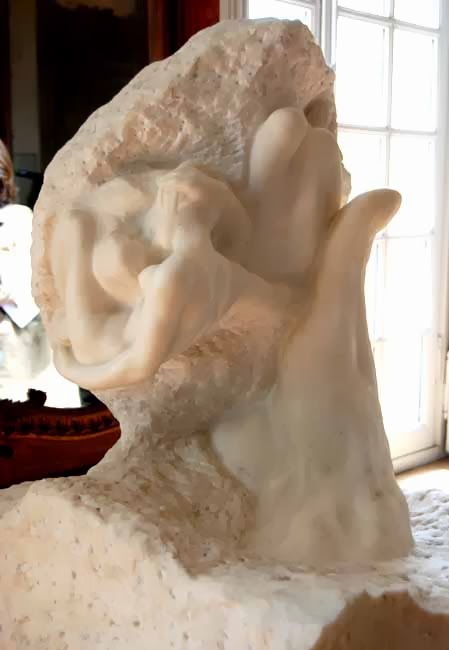
The Hand of God

Another view of The Hand of God - also known as Creation

In The Hand of God, God's creations emerge from his massive hand as if from a womb. Rodin left some of the block rough cut. I think the rough block contrasting with the smooth perfection of the hand adds to the impact of the work.

Rodin often repeated images. He took images of Adam and combined them to form The Three Shades.

The Three Shades - Rodin Museum in Paris

The Burghers of Calais is another famous work.  It took Rodin 10 years to complete this sculpture, and then it was attacked for its appearance. The story goes that the English king, Edward III, agreed to spare the population of Calais if the six most notable burghers (town leaders) came to him bareheaded, barefoot, with a rope around their necks (August Rodin: Sculptures and Drawings by Gilles Neret, Barnes & Noble Books, NY, 1995,  pg. 50). Rodin's vision of these men and their willingness to be humbled in order to save their people was considered to be lacking in grandeur. However, over time, his vision of the work won out, and his insistence that the work not be elevated on a plinth adds to its emotion. 

The Burghers of Calais

Rodin is quoted as saying "Nothing is a waste of time if you use the experience wisely."  Good advice from a talented artist. Rodin died in 1917.  Happy Birthday, Auguste Rodin! Thanks for your amazing contributions to the art world.

Rodin in his studio.

 For more information: The Rodin Museum in Paris 

Sunday, November 10, 2013

Living in Thanksgiving - Perception & Gratitude


"Gratitude bestows reverence, allowing us to encounter everyday epiphanies, those transcendent moments of awe that change forever how we experience life and the world."  --John Milton

Perception is a key component of gratitude. I look at perception in two ways...first, I am more grateful if I pay more attention to the things I see and the things I have, and second, I am more grateful if I am more aware of my own situation.  

When I take the time to notice a flower in bloom or a bird singing, I have a more grateful heart. So for this month, as I work on being more grateful, I am committed to noticing beauty around me.


Although I am uncomfortable comparing myself to others as a way of navigating life, I do find that being aware of worse situations can make me appreciate my own. For example, when I talked to people during chemotherapy treatments, I often went away being grateful for the realization that if I had to have cancer, at least I had a kind for which there were pretty effective treatments.  When my son was diagnosed with Tourette's Syndrome, I learned to be grateful that he did not have a life-threatening disease. I don't think it is necessary to compare myself to others to see these things, but becoming more aware of what other people are dealing with makes me more comfortable with, and more appreciative of my own situation. 

So, for this week, I am going to be more aware of what I do have, and not focus on what I don't have. Appreciating my blessings in life greatly increases my feelings of gratitude!

For more on gratitude see Living in Thanksgiving - How Grateful Are You?

and Living in Thanksgiving - Gratitude Journals, Yes or No?

Friday, November 1, 2013

Living in Thanksgiving - How Grateful Are You?


Every November, about half way through the month, I realize that I wish I were reflecting more on being thankful and expressing gratitude. It usually hits me when I realize friends have been expressing thanks daily for things in their lives via social media. I often think "Oh, I wish I had done that."  I want Thanksgiving to be more than the speed bump between Halloween and Christmas. So, this year, I am working on cultivating an attitude of gratitude throughout the month of November. I am hopeful that working on this intentionally for a month will give me good habits for the upcoming year.

Why gratitude? According to an article "In Praise of Gratitude" found in a health newsletter from Harvard, gratitude and happiness are linked. It says "In positive psychology research, gratitude is strongly and consistently associated with greater happiness. Gratitude helps people feel more positive emotions, relish good experiences, improve their health, deal with adversity, and build strong relationships." In other words, gratitude helps with all of your basic life skills. Who wouldn't want to feel more positive, enjoy life more, have better coping skills, and have better relationships and health?

Of course, in order to make improvements in life, it is valuable to assess where you are right now. I found a gratitude quiz to measure my current "attitude of gratitude."  I scored a respectable 85% on this quiz, and feel that I am on my way to appreciating life more fully this month.

When I was in high school, a good friend introduced me to a book by legendary basketball coach John Wooden. It was called "They Call Me Coach," and contained many of Wooden's experiences, and also his philosophy of living. I remember being very impressed by Wooden's attention to living life well. He wanted to develop people, not just winning basketball players.  To start off my month of gratitude, here is a quote from John Wooden. It is a great blueprint for my month, and for life.
Be true to yourself, help others, make each day your masterpiece, make friendship a fine art, drink deeply from good books - especially the Bible, build a shelter against a rainy day, give thanks for your blessings and pray for guidance every day. -- John Wooden
Join me on my gratitude quest this month, and spend some time reflecting on the things for which you might give thanks.

See also Living in Thanksgiving - Perception and Gratitude and Living in Thanksgiving - Gratitude Journals, Yes or No?

Thursday, October 31, 2013

Happy Halloween!

Highgate Cemetery -  England

Then away out in the woods I heard that kind of a sound that a ghost makes when it wants to tell about something that's on its mind and can't make itself understood, and so can't rest easy in its grave, and has to go about that way every night grieving.

Mark Twain - "The Adventures of Huckleberry Finn"

HAPPY HALLOWEEN!

Tuesday, October 29, 2013

"Mrs. Biddlebox" - Coping With the Bad Days

I used to take my children to the library regularly, where they checked out an armload of picture books. We would read the books, return them, and take home a new load. One day my son said he wanted to get one of those books again. He called it simply "Bad Day Pie." After quizzing him further, I could vaguely remember the book, but had no idea what the title was. We even asked a very patient librarian in the children's section who tried to help us. It seemed rather hopeless, but eventually, my brain came up with the title, we checked out the book again, it still charmed my son, and eventually he became the owner of his own copy of "Mrs. Biddlebox," by Linda Smith.

Mrs. Biddlebox cover

On a knotty little hill,
In a dreary little funk,
Mrs. Biddlebox rolled over
On the wrong side of her bunk.

So begins the story of Mrs. Biddlebox. Everything in her day is going wrong. In frustration, she announces to her goose:
I will cook this rotten morning!
I will turn it into cake!
I will fire up my oven!
I will set the day to bake!

Mrs. Biddlebox collects the ingredients by rolling up the sky like carpet and yanking down the sun. She sweeps and collects every bit of her bad day and stomps it into cake.

Mrs. Biddlebox with ingredients assembled

Finally, she dances around her kitchen as that bad day cooks, and then settles down to eat her delicious slice of cake.
Mrs. Biddlebox is rewarded with a "merry slice of cake"

The illustrations in this book, by Marla Frazee, are charming and dynamic. It is no wonder my son loved this book with its swirling pictures, rhyming text, and uplifting message. 

I am writing about this book not just because I love it, but because it is Breast Cancer Awareness Month. Author Linda Smith, the bio in the book says, "was Mrs. Biddlebox during her two year battle with breast cancer." Sadly, she passed away in June 2000. However, her positive attitude and creative approach to life live on in this wonderful children's book. Linda, thank you for the wonderful legacy you left behind.  

"Mrs. Biddlebox" is a treasure, and a worthy addition to any picture book collection.

Friday, October 25, 2013

Book Warp 2 - The Changeling by Zilpha Keatley Snyder

Zilpha Keatley Snyder has written over 40 books, three of which were Newbery Honor titles. Several of her books remain on my library shelves, and I felt like it was time to re-visit one of my favorites, The Changeling.


The Changeling is the story of Martha Abbott, who doesn't seem to fit in with her very accomplished, talented, and extremely busy family. She finds a friend in the exotic Ivy Carson, who informs Martha she isn't really one of the Carson clan, but a changeling (a child of magical creatures). The misfit girls become friends, and Ivy introduces Martha to an extraordinary world of make-believe. Martha begins to see she can be so much more than she thought.  Each time Ivy leaves with her family, Martha struggles to find her way on her own. Upon Ivy's return, the two girls easily resume their friendship, and their make-believe games. Ivy literally moves in and out of Martha's life over a period of several years. Ivy's vivid imagination is her escape from her own life...the Carsons are notorious for getting in trouble around town and with the law (hence the frequent moves). Through her friendship with Ivy, Martha begins to outgrow her crying "Marty Mouse" self, and emerges as a more-confident, capable teenager. Ivy continues to work to rise above her family reputation and dreams of being a dancer, but as she enters her teen years, the struggle begins to take its toll. When Martha and Ivy are accused of vandalism at the school, their friendship is tested. In the moment of crisis, would you stand up for your friend? And if the world turns on you again and again, would you be able to stay positive and keep believing in your dreams?

This is a wonderful book about growing up, trying to fit in, and working to figure out who you are. The themes of friendship, loyalty, family, and forgiveness still resonate in this classic novel.

I highly recommend this book. It was originally published in 1970, and it was re-issued a few years ago. Although it seems to be out of print again, you could probably find a used copy. If you are fortunate enough to have this book on your shelves, read it again! This one is still one of my favorites!

Have you read this book? Let me know what you think!

Check out "Book Warp 1 - Reading Blue Willow" here.

Wednesday, October 23, 2013

Breast Cancer Awareness Month - My Walk Through Breast Cancer

Artwife - September 2012

It is here again - October, the month where athletes add pink to their uniforms. I confess I have more awareness of breast cancer than I ever wanted. It dominated the past 16 months of my life! I am not comfortable with the roles of spokesperson, victim, or survivor, but thought in honor of the month, I would share a little of my experience. I have nothing brilliant to add to so many who have boldly shared their information in online chats, blogs and more. Many, many women have given me information, support and encouragement through sharing their experiences either in person or on the internet. Their positive attitudes and strength helped me on many a sleepless night!

I was diagnosed with breast cancer in June of 2012. I found a lump through a self-exam. My treatment regimen included surgery, chemotherapy, radiation, and herceptin. I finished treatment in August 2013, and had my port removed in September. If you are facing treatment and wonder about getting a port, I loved having mine! With 17 treatments and only one arm available for IVs after lymph node removal, having a port was definitely a blessing.

I made the first cut!

My hair loss was predicted to be 100% based on the chemotherapy I was receiving. Sure enough, two weeks after the first treatment, my hair was coming out by the handful. Shaving my hair was not as bad as I feared. It was the one thing I could control. I decided when to shave it, how, who, etc. I made the first cut, and still have my little braid. My husband and son did the rest!

What teenager wouldn't want to cut off mom's hair?

I always wondered how I would look with a mohawk.

Back in the day, we called this "new wave."

It was a LOT of hair!

Me with my husband, and best friend extraordinaire!

I had surgery to remove the cancer at the end of July 2012. Then I started chemotherapy in September. I had 6 cycles of taxotere and carboplatin, and 17 cycles of herceptin.  Chemo is tough--it really is systemic. I had head to toe symptoms, but as a good friend reminded me, that means the drugs are working! Best advice I can give for chemotherapy?  Get through it any way you can! I had people help with cleaning and meals. I used the nausea meds for several days each cycle. I drank flavored water (thanks Mio!) and ate things like rice and Jell-o on the bad days. I slept a lot and tried to get out for a walk once in awhile. I could always taste tomato juice, so I drank that as well. I was happy to leave chemo in the rearview before New Year's.

Lunch at my first chemo, when I still had hair and tastebuds!

My chemo infusions took between four and five hours. I read, slept, watched DVDs, played cards, and ate lunch during my treatments. Getting chemo never particularly bothered me during the infusions, it was the week after that was tough! My treatment regimen was given every three weeks.

Getting my wig cut and styled.

Before I shaved off my hair, I went wig shopping. It was actually fun to try on so many styles! I haven't been to my own hairstylist in over a year, so I felt I could justify spending money on a good wig. Mine was synthetic, which meant it held its style, and I only had to wash it in a sink about once a month. That was a blessing, since I didn't feel very good during chemo. My hair began growing back in January 2013. By May, I was done with the wig...too hot and uncomfortable for summer. My hair is not as curly as everyone promised it would be, but at least it all came back!

Washing my hair in the sink!

I finished chemotherapy December 27, 2012, and started radiation in February 2013. The most difficult part about radiation is the fact that you have to go 5 days a week, so it feels like that is all you are doing. The treatments are short. I had a couple of preparatory appointments that involved getting my tattoos, and getting the machine alignment all set for my treatments. The actual time of receiving radiation is very short. I counted once during the radiation cycles, and the longest "zap" was about 25 seconds, with some lasting only about 10 seconds. I received radiation from a few different angles each treatment.  My radiation team was so much fun...they made it easier to be there. I finished in March after 25 cycles.

Me by the machine that gave me my radiation treatments.

Ringing the bell! It was great to be done with radiation!

I had some skin side effects from radiation including one really huge blister, redness, and some raw skin. A few weeks after treatment, I went through a lot of peeling. To help my skin, I used Aquaphor and Eucerin. I also used Mepilex at the end when my skin was pretty raw. Talk to your nursing team...they are a great resource for getting you through all of your treatments.

An autumn outing during chemotherapy.

Sun feels good on a bald head, and so does the hot water in the shower! No matter what I was going through during my cancer treatments, I could usually find some small thing that was positive!  And I was always grateful that there were treatments available for me.

My family, friends, and my faith were keys to my coping ability during my months of cancer treatments. I can never thank them, or God, enough for all they have done for me.  I believe in the power of prayer to strengthen both emotionally and physically. I have felt it.

For those of you facing cancer, I have this to offer you:  treatments end, hair grows back, bodies heal, and life goes on. Live every day...you only get one shot at life!

For those of you who haven't had this lovely experience in your lives, get your cancer screenings! They may save your life!

My other writing related to my cancer:


Wednesday, October 9, 2013

What is Art?

The recent reports of Banksy art appearing in New York City, (and being "ragged," or defaced), reminded me of watching the film "Exit Through the Gift Shop."  This little project was directed by the famed street artist himself.  Although I was familiar with some of Banksy's work, I particularly enjoyed seeing shots of his projects on a wall by Gaza in Israel.  Many point out the whole documentary is in itself but a piece of Banksy art that the illusive artist is fooling us once again, I think there is more to this film than that.  It is a portrayal of  how street art is created, a glimpse into the humor of the artists involved, and it is an addition to the dialogue about what constitutes art.

Banksy art in Gaza

What is art?  Is it legitimate art if it is painted on a railroad car?  Does comic book art count as art?  Is a fine artist more worthy of acclaim than an illustrator?

As a disclaimer, most of my artist acquaintances fall in the category of illustrator, although several of them produce work successfully in both arenas.  What is the difference between fine art and illustration?  Depends on who you ask.  One definition I found says "fine art" is sold in a fine art gallery.  So if an illustration is sold in a fine art gallery, by that definition it becomes "fine art." Almost any kind of art has been sold in a fine art gallery, including street art by people like Banksy.  So does that then make a street artist into a fine artist?

Another argument commonly put forth is that illustration is contracted in advance, and fine art is sold after its creation.  Does this then make the Sistine chapel ceiling painted by Michelangelo illustration?  It was definitely a commissioned art project.  It is also very narrative, another gripe the fine art community has with illustration.  Illustration, they say, is too tied to following a story line.  But following a story line is exactly what Michelangelo did in his masterpiece, as did many other artists of his era.  So, is he an illustrator?  By these definitions, he is perhaps the ultimate illustrator.  (And the illustrators themselves are happy to claim him).  Many artists accept commissions.  Most of them do wish to earn a living.  Does that then make the piece they produced NOT fine art?

Sistine Chapel Ceiling

As street art, comic book art, and various other forms of art find their way into galleries and museums, the line between illustration and fine art blurs.  Norman Rockwell, while lauded by many as an incredible draftsman, is often shunned by the fine art world.  Why?  Because his work was published so widely?  He wasn't a good enough "painter?"   If you ask the average person, they would be familiar with Rockwell's art, and would identify him as a legitimate artist.  Why then, do so many take issue with him and his legacy?  One criticism I read said his work was too sentimental, a sugar-coated view of life.  But isn't an artist's expression of his personal vision what makes his creation art to begin with?  Does a piece of art have to be edgy, tawdry, or controversial to be fine art?   When you look at the prices and acclaim a  Monet landscape can garner today, obviously not.

Norman Rockwell

Any genre of art receives a substantial amount of criticism when it begins.  The impressionists were panned.  In fact, the label, "impressionist" was not complimentary when given.  Picasso likewise was not at first embraced as he veered from the traditional school of art.  Van Gogh died in poverty without ever selling a painting.  Are these not artists?  Are they not considered "fine artists" today?  They were scorned by the experts at the time they began their unique artistic journeys.

 So, perhaps pop art, street art, and comic book art are the next versions of fine art.  After all, who decides?  If you are too successful, are you no longer an artist because "starving" can be removed from the front of your name?  Does being bankable make it not art?  Yet almost any artist, honestly, wants to have enough recognition and money to keep going.  And some of them want to make even more than that.  Yet artists themselves can quickly point fingers and label others as sell-outs.  A prime example of someone being the victim of his own success is Thomas Kinkade, who has been one of the more prolific and marketable artists of the last several years.  As his success increased, however, so did the criticism from his peers.  I have heard people question his legitimacy as an artist, and some are quick to say he "sold out."  When, in the art world, did Kinkade's work ceased to be "art"?

Perhaps the definition of art that is foisted on the public is just that...foisted on us, by art professors, and gallery owners, and those who think they know better.  If you think gallery owners are in it for "art" and not money, I think you are mistaken.  Clearly a gallery owner is in business and wants to turn a profit to keep his/her gallery open.  However, what does a gallery owner mean when they tell an artist their piece looks too much like illustration?  Every owner has the right to determine what they hang in their gallery, but are they the only ones qualified to determine what is art?  If those who sell and promote art get to define it, then perhaps the public is the loser for buying into the rhetoric that they sell.  Perhaps art is in the eye of the creator, and in the eye of the beholder.  Perhaps the Rembrandt print on your wall, or the Japanese manga in a kid's room, or the Banksy you walk by on the street, or even the wonderful creation your child brought home to showcase on your refrigerator is all really art. If you love it, maybe that is all that matters.

Banksy himself, in his film, says Mr. Brainwash did not follow the rules in achieving his level of success.  Then he says "But there aren't supposed to be any rules."  May I suggest that juxtaposition of ideas is a great summary of the whole discussion.  In art, creativity and innovation are both sought after and scorned.  Definitions change to fit the circumstances of the one doing the defining.  Your best bet may be to decide what YOU think is art, and stick to it...until the next big thing comes along. And if you happen to be in New York this month, keep your eyes open. You may just get to see some Banksy art along the way!

Note:  "Exit Through the Gift Shop" carries an R rating.  It does have a few uses of the "R-rated" expletive (about on the level of a few PG-13 movies today).  It also is cleverly crafted and often funny.  Is it the real deal or have we all been tricked by another Banksy project?  Were you brainwashed by Mr. Brainwash?  Are art collectors brainwashed into buying the next new thing?  As with any art, the interpretation of this film is entirely up to you.

Tuesday, September 17, 2013

Football, Fall, and Film - My Favorite Football Movies

Movie poster for "Undefeated"

Autumn is in the air, and that means football! I live in Utah, where football stadiums are graced with views of the Rocky Mountains carpeted in trees turning red and gold this time of year. It is a beautiful sight, and makes for some wonderful evenings watching football. I also like watching football movies.

I just watched the 2012 Academy Award winning documentary, Undefeated.  What a movie! If you aren't familiar with this one, get into the spirit of fall football and catch this uplifting story. Bill Courtney volunteers, that's right, folks, volunteers for six years to coach the Manassas Tigers high school football team in North Memphis, Tennessee. To say that this football program is struggling is an understatement. After the closing of a Firestone factory, this part of town dies. The football team has not won a game in years. Enter Bill Courtney. For some reason not explained in the documentary, he wants to coach this team.  And in six years, he builds a program, and more importantly, he builds young men. 

Coach Bill Courtney (left) on the field.

This film follows Coach Courtney and the players, particularly OC Brown, Montrail "Money" Brown, and Chavis Daniels. All of these young men have struggles. OC has the potential to play college ball, if he can make the grades. Chavis is returning to the team after missing his sophomore year serving time, and Money suffers an injury that takes him out of the game. Will he be able to return before the end of the season? I am not giving any spoilers here, but taking the journey with these kids has some nice pay-offs at the end. Filmmakers Dan Lindsay and TJ Martin do a marvelous job of making the viewer care about these players, this coach, and this team. I found myself pulling for these kids to make it not just in football, but in life, and there were moments when I found my eyes tearing up. At the beginning of the film, Coach Courtney says:
"The foundation has got to be a solid platform that you can stand on and speak to these kids and say this is the way you build yourself. If you build yourself this way and handle yourself this way, and have character, you get to play football. And winning will take care of itself because young men of character and discipline and commitment end up winning in life and they end up winning in football. But when you flip it, and the foundation of what you are doing is football, and then you hope all that other stuff follows, well then you think football builds character which it does not. Football reveals character."
Amen, Coach. And thanks to all involved for giving us this uplifting story!

Can't get enough football? Check out my other favorite football movies (they are all based on true stories).

Movie poster for "The Blindside"

The Blindside tells the story of Sean and Leigh Anne Tuohy, and how they take Michael Oher out of foster care and him part of their family. It is an amazing story of reaching out to save a fellow human being. Michael experiences stable home and family life for the first time, and is able to get through high school and make it to college with the love and support of this family.  I am always amazed that one family can open their hearts and their home and make such a difference. 

Quinton Aaron portrays Michael Oher in the movie, The Blindside

The movie features the acting talents of Sandra Bullock as Leigh Anne Tuohy and Kathy Bates as Michael's tutor. Oher has spent most of his upbringing in foster care, the son of a mother struggling with addiction. When he is enrolled in a different school, mostly for his athletic ability since his academics are lagging behind, his life begins to change. He is befriended by the Tuohy family, and is eventually adopted by them. Football is a sideline in this tender story. As you may know, Michael Oher went on to play in the NFL. The Blindside is rated PG-13.

Real-life family: Sean and Leigh Anne Tuohy, Michael Oher, Collins and Sean Jr.

Remember The Titans movie poster

Who doesn't love Denzel Washington in Remember The Titans? This 2000 movie tells the story of coach Herman Boone (Washington) who became the coach of racially segregated T.C. Williams High School in the 1970s. It is a difficult task to integrate the football team, and the story is engaging. Although the movie received mixed reviews, it is an appropriate vehicle to introduce civil rights and racial and social issues in a family setting. It also has some nice football moments. And did I mention it has Denzel Washington? Remember the Titans  is rated PG.

Image from Remember The Titans

The first time I saw Invincible, I remember thinking "these people are always in a bar!" Maybe I was hyper-sensitive to that because I had my kids with me at the time. The movie ran recently on TV, and I found myself watching it again. I had forgotten how much I enjoyed this film!

movie poster for Invincible

Invincible tells the story of Vince Papale who, at age 30, becomes a Philadelphia Eagle. The movie version has Papale (played by Mark Wahlberg) as a bartender who rather miraculously impresses the Philadelphia coaches at an open tryout and makes the team. In reality, Papale had been playing semi-pro ball, so making the team in real life was not quite the leap it is in the film. Still, to have a 30 year old achieve his NFL dream when many people would have written him off due to his age is a wonderful story. The likable Greg Kinnear plays Eagles coach Dick Vermeil. Invincible is rated PG.

Mark Wahlberg as Vince Papale in Invincible

Lastly, I liked the movie We Are Marshall. This is a story of rising out of tragedy.

movie poster for We Are Marshall

In 1970, a plane crash killed all 75 people on board, including 37 members of the Marshall University football team, several coaches, trainers, and the athletic director. Football boosters and airline crew members also died. It was a horrible event. According to the film, Marshall University considered suspending its football program after the crash. As you can imagine, losing that many people in your football program would be pretty devastating. However, there were still players on the team (many new players who had not made the trip), and the university makes the difficult decision to hire a new coach and move forward. This movie tells the story of healing and rebuilding in the wake of the crash. Matthew McConaughey stars as the new football coach at Marshall, and Matthew Fox plays his assistant. I found myself rooting for this school and this program to rebuild and get past their grief after this tragic event. We Are Marshall is rated PG.

Matthew McConaughey leads the charge in We Are Marshall

There you have it--my football film picks for this fall! All of these movies are fairly family friendly. The documentary is not rated, and does have some language. But it also has a coach admonishing his players and asking them not to make him mad enough to swear at them again, since he had to go home and pray for forgiveness! All of these movies have positive messages about life, not just football.

What are your favorite football movies?

Monday, September 9, 2013

Fortune to Fake and Back Again - Van Gogh Painting "Discovered"

Van Gogh's Sunset at Montmajour

The Van Gogh Museum in Amsterdam unveiled this painting today, declaring it a work of famed artist Vincent Van Gogh.  This painting has spent much of its life lying in an attic.  Originally painted in 1888, it was in the possession of Vincent's brother, Theo.  The painting passed from Theo to an art dealer, who did not record the sale of the painting, creating a gap in the provenance. The painting is unsigned, and was originally rejected by the museum as a fake for that reason.

So why is it considered authentic now? Vincent wrote letters regularly to his brother, Theo. In one letter, he describes this painting, and says he painted it the day before (July 4, 1888). 
"At sunset I was on a stony heath where very small, twisted oaks grow, in the background a ruin on the hill and wheat fields in the valley. It was romantic. ... The sun was pouring its very yellow rays over the bushes and the ground, absolutely a shower of gold."
 In Theo's collection, the painting was numbered 180, and that number is on the back of the painting.  The subject matter matches the description in Vincent's letter. The brush strokes look typical of Van Gogh as well, though this piece is considered a transitional work as the artist progressed to his famed thick strokes of paint.  In essence, through his writing, Vincent was instrumental in authenticating his own piece of art.  What could be better than that?

A Norwegian industrialist bought the painting in 1908, and was told it was a fake.  He banished it to the attic. In 1970, the painting was again declared a fake.  It changed hands, and in 1991, the museum declined to authenticate it. This wonderful piece seemed doomed to a lifetime of obscurity.  However, it has now "resurfaced" and with technical evaluation of pigments and the written record of Vincent himself, it has been officially declared a Van Gogh...again (since Theo sold it as a Van Gogh originally).  Thanks, Vincent, for another beautiful treasure in a wonderful body of work!

If you would like to know more about the modern processes involved in authenticating artwork, check out the wonderful BBC series, Fake or Fortune.  These shows are entertaining, as well as educational.

You might also be interested in my other blog posts about Vincent Van Gogh in Auvers-Sur-Oise, and a painting that many claim is a work by Leonardo DaVinci.