Showing posts with label Bear River Migratory Bird Refuge. Show all posts

Thursday, October 18, 2012

Bear River Migratory Bird Refuge in Autumn

Great Blue Heron

Since it is National Wildlife Refuge Week we decided to head north to the Bear River Migratory Bird Refuge to see the fall migration.  About a week and a half ago, I checked the bird count on the refuge's website, and saw certain birds were at the refuge in the thousands.  However, days later, oh how things had changed!

Ducks in the distance

The ruddy ducks, northern shovelers, and other birds that had been listed in high numbers had all but disappeared on their journey south for the winter.  We could see a large number of ducks in the distance, but they were keeping to an area we could not access.  Even with our binoculars, we could not positively identify most of the ducks we saw.  Duck hunters were in the area, and some had quite a brace of birds, but they were scarce for us!

Long-billed Curlew

Fortunately, some birds stay at the refuge all year, and other birds were still passing through..  We spotted some birds familiar to us from our previous visit (like flocks of red-winged blackbirds), but also added some new birds to our list like this Long-billed Curlew.  We also saw pelicans flying overhead and sunning on an island in the water.

Clark's grebe

New this time for me was a view of this Clark's grebe.  It differs from the Western Grebe in that the black on its head does not extend below the eye.  Both types of grebe were present in the water.

California gulls

The gulls were everywhere, including lining the roads.  One of the highlights for me was the abundance of Great Blue Herons. They stood on the roadside, often on one long leg.  As our car approached, they would lower their leg and prepare for flight.  We saw at least a dozen during the 12-mile auto-tour loop.

Great Blue Heron

Great Blue Heron in flight

We also spotted over a dozen Northern Harriers.  These large predators glide low to the ground over the weeds to spot their prey.  We saw one eating a mouse by the side of the road.

Northern Harrier eating a mouse by the road

Northern Harrier in flight

At one of the observation decks we saw what looked like owl pellets.  They may have been from some other large bird.  Birds cough out these pellets containing the remains of their meal that did not digest.  My husband kicked one open on the decking, and we could see small animal bones leftover from a meal.

Bones in an "owl" pellet.

Near another observation deck, the mud was drying into a beautiful geometric pattern.  The autumn reds and golds of the weeds and grasses contrasted with the deep blue of the sky.

Patterns in the drying mud.

Before we left, we stopped to picnic in the parking area at the beginning of the loop.  A skunk ambled past the restrooms and our vehicle, and began exploring the grasses.  We stayed safely in the van until the skunk was past spraying distance.  If you go visit the bird refuge, keep an eye out for other wildlife.  In the spring we saw otters and a badger. This fall, we saw the skunk.

Skunk takes a stroll


Bear River Migratory Bird Refuge in Autumn

The weather during our October visit was perfect, and the scenery was beautiful.  Even if we were not there during a big migration week, we enjoyed our visit and added several birds to our list.

Admission to the auto-tour route at the Bear River Migratory Bird Refuge is free.  The loop is open year round, but does close at times due to flooding or snow.  It is advised that you call ahead to check the road conditions.  The population here changes constantly.  We are anticipating the return of the tundra swans who pass through the bird refuge every spring and fall.  Bald eagles will be coming soon, too, as the weather gets colder.  Unlike many of the other birds, the eagles come to Utah for the winter.

If you go:  You can reach the Bear River Migratory Bird Refuge from Salt Lake City by traveling north on I-15.  Take exit 363, Forest Street in Brigham City. At the end of the off-ramp, turn left and travel west until you reach the auto-tour route.  You will pass the visitor's center just west of the freeway.

Wednesday, May 23, 2012

Birding in Utah - Part 2

Barn Swallow

Our morning visit to the Bear River Migratory Bird Refuge began with swarms of swallows flying around us.  As we approached their mud nests, they abandoned their homes and swirled around the area.  I don't know if they were trying to distract us, or were just waiting for us to leave so they could return to their nests.  We saw both barn swallows and cliff swallows.  The cliff swallows had a light colored patch on their heads.

A cliff swallow works on his mud nest.

We saw swallows down near the water getting mud for their construction projects.  These nests were under every eave near bathrooms and under pavilion roofs.

American Avocet

We saw several water birds, including this American Avocet.  The rosy colored head is indicative of breeding season.  In winter, these birds have a white head.

A Black-necked Stilt

The black-necked stilt had bright pink legs!  I enjoyed watching these long-legged birds walk.

Cinnamon Teal

The brightly colored cinnamon teal was a favorite.  It was easy to pick this bird out, even from a distance, because of its rich cinnamon color.  The female on the left is much duller in coloration.

Canadian Geese and Goslings

Driving in to the refuge, we saw several Canadian geese in fields.  As we drove the auto-tour loop, however, we saw families of geese.  They swam away from the shore as we approached, keeping their goslings safely between the parents.  These goslings were much larger than the first ones we saw, and fewer in number.

Franklin's Gull

At first I thought this might be a Bonaparte's gull, but the Franklin's gull has a distinctive red beak.  When we looked through the binoculars, it was clear that this fellow sported the red beak, and therefore, we determined it was the Franklin's gull.  The Franklin's is more common in this area anyway, so it made sense.

American Coot

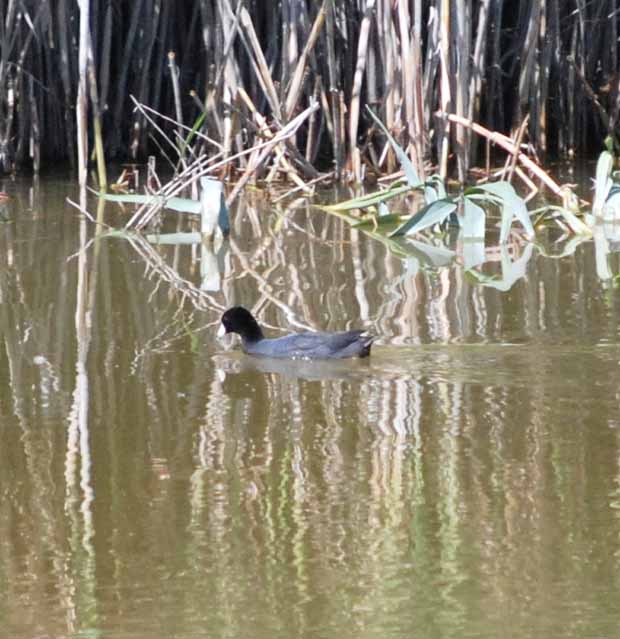
The American coot looks a lot like a duck, but is not considered to be a duck since it does not have webbed feet.  It has large lobed toes instead.  It is the only all-black bird with a white bill.  We saw several of these, and they became a favorite as they were easy to identify.

California gull

As we drove, we saw several gulls standing on what looked like pieces of wood.  However, as we got closer, we realized the "logs" were really dead carp.  I am not sure why they died.  The water level was lower in this channel, and perhaps these big fish were trapped without enough water.  The gulls were ready for a feast, though!

Western Grebe

During breeding season, the black on the head of a western grebe extends down to its eye, and often below the eye.  It is also identified by its red eye and yellow bill.  The Clark's grebe is similar, but has an orange bill and the black does not extend to the eye.  We saw many western grebes during our drive.  Sometimes they move their necks back so that their heads are practically resting on their backs.  I enjoyed seeing the birds exhibit this behavior.

Western grebe with its head pulled back.

Yellow-headed blackbird.

Yellow-headed blackbirds were everywhere.  The white on the wing was more visible when the bird was in  flight.  I even learned to identify the females which are a lighter brown with a yellow-brown head.  We also saw several red-winged blackbirds.

Red-winged blackbird.

The red patches on the wings are particularly brilliant when these birds are in flight.  

American white pelicans.

I have occasionally seen a pelican, but it was great to see these birds in larger numbers.  We watched them floating  on the water, walking on the shore, and flying in the air.  These are big birds, and it was beautiful to see several of them flying together.

Pelican in flight.

One of the observation decks along the auto-tour route.

Parking is available at several pull-outs along the drive.  The observation deck offered a different perspective of the refuge.  This is a great place to use your binoculars.  The views from the deck were beautiful.

View from an observation deck.

There were lots of mosquitoes, however, and we were always happy to return to the car.  At one point along the drive, we saw a badger look at us, then duck into his burrow.  At another stop, we saw otters swimming in the water.

Otter in the water.

The small killdeer ran along the side of the road.  They were also fun to watch, but blended in well with the dirt and gravel.

Killdeer

I think one of my favorite birds of the day was the snowy egret.  These birds are beautiful. Their white feathers are tufted and soft looking at the back of their heads, and they also scrunch their heads down sometimes, so that their neck almost disappears.  The very best part, however, is the fact that they have big yellow feet.  Really!  Black legs, and big yellow feet.  I wasn't able to get a photo of their feet, as the ones I saw were standing in the water.  However, when they took off in flight, we could see their yellow feet.

Beautiful plumage of a snowy egret

As we finished our auto-tour, we pulled into the parking area by the last observation deck.  I wanted to get a better photo of a white-faced ibis, and one was conveniently posing near the road.  

White-faced ibis

We debated whether or not we should go up on the last observation deck, but we were a bit intimidated by the swarms of bugs.  Also, we felt like we had seen a wide variety of birds, including two great blue herons that we enjoyed watching take off, but were unable to photograph.  The consensus was everyone was tired and hungry, and it was time to finish our tour.  As I looked out the passenger window, however, I spotted a big bird trying to blend in with the grasses.  It stood with its head pointing up, like a weed, and held really still.  I had no idea what it was, so I pointed it out to my passengers.  One of them said, "American bittern."  Sure enough, as we double checked the guidebooks, there it was.  An American bittern.  I had never even heard of this bird before!  And now I have seen one.

American bittern.

The American bittern has green legs.  If you look closely at the photo, you can see them.  We had a great time birding, and hope to return to the Bear River Migratory Bird Refuge again.  Since it is only a bit more than an hour from Salt Lake, I plan to return to see migrating birds this fall.  I am also going to try some other birding sites in Utah.  We saw a few other birds that day that I did not capture in photos, such as the eastern kingbird, mallard ducks, and a cowbird.  Overall, it was a great experience and a fun family activity.


Tuesday, May 22, 2012

Birding in Utah - Part 1

View of the water at the Bear River Migratory Bird Refuge

Have you seen "The Big Year?"  This 2011 movie starring Jack Black, Steve Martin, and Owen Wilson is about three men pursuing a "big year" in birding--trying to see the most birds in one calendar year.  The prize?  A ranking in a birding magazine indicating who had the highest counts.  Oh, and I guess personal satisfaction is the real reward.  The whole competition works on the honor system. This is a great little movie you may have overlooked.  After seeing it last year, I started learning a bit about birding opportunities in Utah.  

Western grebes - Bear River Migratory Bird Refuge

My birdwatching experiences have been very casual.  We had a bird feeder at our house when I was young, and I learned to identify common backyard birds such as robins, house finches, sparrows, juncos, and black-capped chickadees.  Since then, I have expanded my knowledge base to include several other local birds, and I have seen some interesting birds on vacations.  I even know a few birds by their calls, but that has been the extent of my birding adventures.

View from an observation deck .

I have learned that Utah is a major migration pathway for several species of birds.  This gives many opportunities to see a variety of species practically in my own backyard.  With that in mind, I loaded the kids in the car and we took off for the Bear River Migratory Bird Refuge.  Most of the spring migrations took place in March and April, so we were focusing on seeing species that live at the refuge year round, or that come for breeding and nesting season.  I do want to return in the autumn months to see some of the migratory visitors.

Cliff swallows fly close to their nests.

It took us about an hour and fifteen minutes to reach the bird refuge from Salt Lake.  Take I-15 northbound to Brigham City.  In Brigham City, take the Forest Street exit (Exit 363), and travel west on Forest Street until you reach the bird refuge (about 12 miles).  You will pass the visitor's center not too far off the freeway.  We opted not to stop at the visitor's center, but continued on to the auto-tour route.  This is a 12 mile loop on a one-way road.  Sometimes the road is closed because of weather conditions, but normally it is open during daylight hours year round.  There is no fee to visit the bird refuge.

First birds of the day!

We stopped in the first parking area (there are toilet facilities here) and began our birding adventure.  Since I am a complete amateur at this, I wondered if we would have any success.  However, I learned that a little preparation goes a long way in helping everyone have a successful birding experience.  Here are my bird watching tips:
  • Take binoculars.  We had six people in our group and shared 3 pairs of binoculars.
  • Download the bird list from the Bear River Migratory Bird site.  This list tells you which birds are at the refuge in which seasons, which birds stay year round, which birds are common and which are rare, etc.  I also checked the website before we went to see which birds had people had been seeing in large numbers.  This gave me a pretty good idea of which species to look for before we hit the road.
  • Take a guidebook.  We had a couple of different books with us, one specific to Utah, and one specific to North America.  Both books were helpful.  
  • If you are birding with small children, consider printing out pictures so they can compare the photos with the birds they are looking at.  The visitor's center would also be a good place to visit with small children.
  • Take food and something to drink!  I was too lazy to pack snacks for this trip, and we did get a little hungry and thirsty.
  • Take bug spray!  I didn't even think about it, but since this is a marshy area, the mosquitoes are large and healthy.
  • Take a notebook to record which birds you see.  We identified 23 species of birds in the time we were at the bird refuge.  There were a couple birds we could not identify, but overall, we were satisfied with our success.
Franklin's Gull

This was a lot of fun.  It took us about 2 hours to drive the auto-tour route.  We stopped at several parking pull-outs, and both observation decks.  I don't think you are supposed to stop along the road, but we did several times since there were no other cars in sight.  We encountered a few people fishing, but there were no crowds on the auto-tour, and it was a Saturday morning when we went.

American Crows greeted us on the drive.

I highly recommend a visit to this bird refuge.  In my next post, I'll showcase some of the birds we saw during our visit.  Have you ever been birding?  What are your favorite birds?